Interview Racheal Stones 2026 Hope Rises Book Release
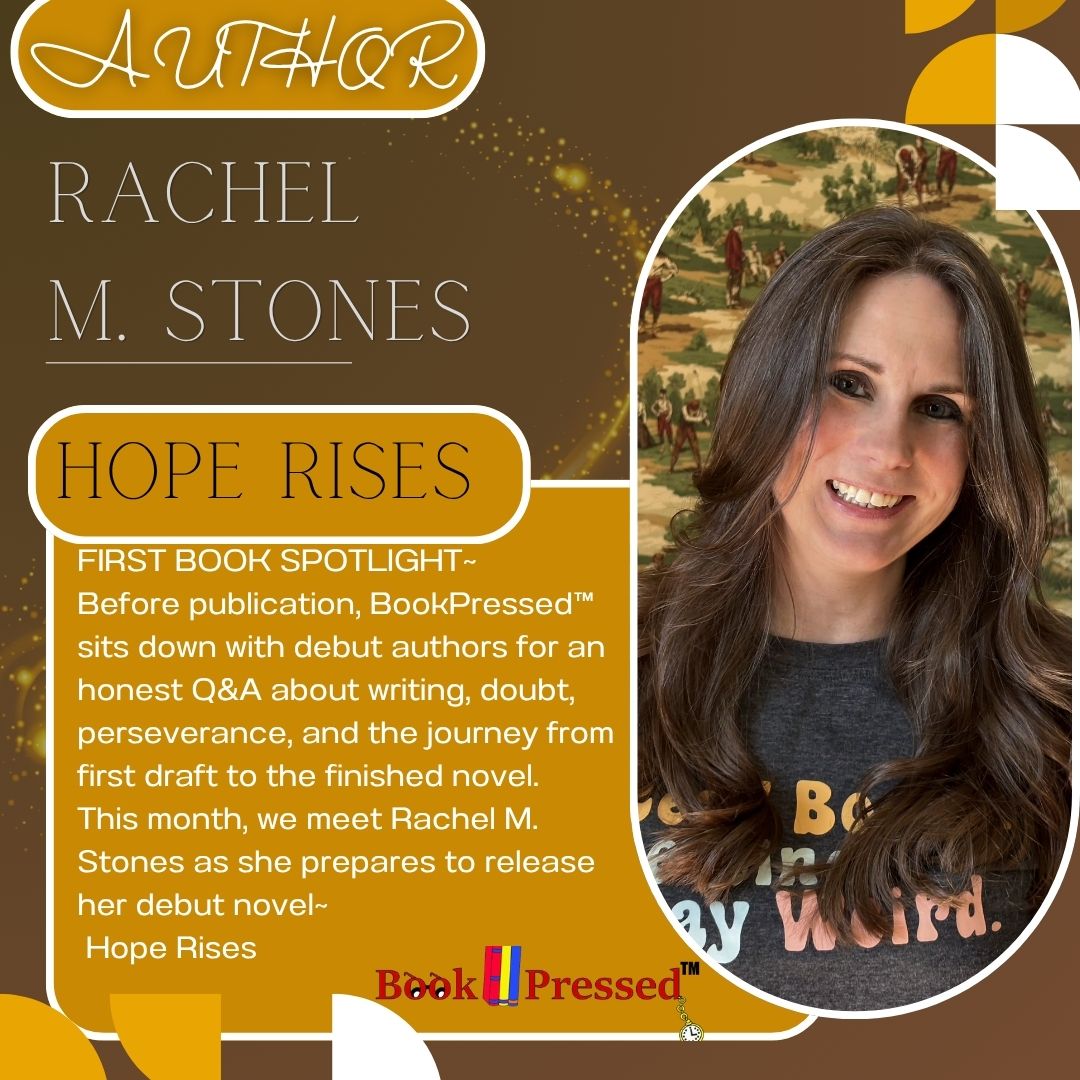
AUTHOR SPOTLIGHT – THE FIRST BOOK
1.) You have completed a novel – A goal many people dream about but never reach. When did you first realize, "I'm actually going to finish this book"?
I'm not the type of person who starts something like this and then puts it away. If I had, the story would have haunted me every day until I completed it. So, for me, it wasn't really when I thought I would finish, but more of when I knew I would publish, even if I couldn't find a traditional publisher. A member of my bookclub asked to read one of my earlier drafts before I had even done a developmental edit. She was working as a test proctor and couldn't have any devices, so she printed the book four to a page and read it while proctoring exams. One week later, she asked me to join her for coffee and then asked me a dozen questions about the book. She was truly excited about the characters and the story, and even though she did not usually read fantasy books, she said she devoured this one and couldn't put it down. Her excitement made me believe that I had something that people might actually want to read and characters to fall in love with.
2.) Looking back at your earliest draft and the manuscript you have today, what changed the most—your story or you?
With the exception of my final pass through a manuscript, my stories tend to grow during edits rather than shrink. It's probably a terrible habit at this stage of my writing career and something I'm actively trying to improve.
The first draft of Hope Rises was around 150,000 words. The final manuscript came in at roughly 176,000 words, and at one point it ballooned to more than 183,000. Every round of edits seemed to spark new ideas, deeper character moments, or additional scenes that I felt made the story stronger.
As for me, I definitely changed throughout the process as well. Writing a novel taught me a lot about patience and the publishing industry. It also taught me that stress eating is apparently one of my superpowers. So while the story grew by tens of thousands of words, I may have grown a little too.
3.) Every first-time author reaches a point where they wonder if they're good enough. Did you ever experience that moment, and how did you push through it?
This is something I still struggle with today, even with my debut novel only two months away from publication.
For me, those feelings tend to hit hardest during the editing process. The entire purpose of editing is to dissect your writing and identify flaws, inconsistencies, and areas for improvement. If you spend too much time editing and not enough time creating something new, all you hear is critique. Over time, that can start to weigh on you.
At first, you're asking questions like, How can I make this scene better? or How can I strengthen this character arc? Eventually, those questions can turn into something much bigger: Is this book good enough to be published?
That's usually when the comparisons start. Will readers who love my favorite authors enjoy my book? Am I anywhere near their level as a writer? Why am I even doing this?
When that happens, I remind myself that the authors I admire have spent years honing their craft. Many of them have written dozens of books. Chances are, they weren't the writers they are today when they published their first novel.
So when the self-doubt creeps in, I try to focus on stopping the comparisons, take some time to write, even if it's just a poem, and remind myself that my goal is to be a better writer with each book I publish. That is something that is very achievable.
4.) What surprised you most about the publishing process that nobody warned you about?
You expect drafting and editing. That's a given. What I wasn't prepared for was just how many rounds of editing a book goes through before it's ready for readers.
I probably self-edited Hope Rises four times from beginning to end before I ever sent it to my developmental editor. Then I revised it again. Then it went to my copy editor. Then I made additional revisions. Then it went through proofreading. Then I made more changes. At some point, you start wondering if you'll ever stop finding things to tweak.
But honestly, editing wasn't the biggest surprise. It was everything else.
Finding editors. Hiring artists. Working with a cover designer. Registering copyrights. Choosing distribution platforms. Planning an ARC campaign. Managing an ARC campaign. Setting up a website. Coordinating audiobook production.
And, of course, marketing.
If you want readers to discover your book, marketing becomes a daily or near-daily part of your life. Writing the book is only one piece of the puzzle. Once the manuscript is finished, you're suddenly wearing the hats of author, publisher, marketer, project manager, and business owner all at the same time.
I had no idea how much went into publishing a novel when I started this journey. It can be a little overwhelming and at times, feel impossible. I'm a 43-year-old woman who is trying to create TikTok videos and be trendy for crying out loud. Key emphasis on the trying lol. It's important to find others who have gone through the process and lean on them for advice and guidance.
5.) If you could go back and speak to yourself on the day you wrote Chapter One, what advice would you give?
Slow down.
I would tell myself not to rush so quickly toward the end just because I knew where the story was going. Take more time with the moments that matter. Let the important scenes breathe. Make sure the emotions I wanted readers to feel were actually landing on the page.
I would also tell myself to start learning the marketing side much earlier. Read books on marketing and seek guidance to understand the marketing strategies that have helped other authors.
6.) Was there ever a point where you almost stopped, shelved the book, or walked away from it completely?
Yes. There was a point when I seriously considered shelving it.
When I queried the book to agents, I kept getting the same response: it was too long. Often, that was followed by the suggestion to cut around 30,000 words. As a new writer, I just stared at the manuscript thinking, How? How could I cut that much without fundamentally changing the heart and intent of the story?
I considered splitting it into two books, but my beta readers were adamant that I shouldn’t. And maybe, if I had signed with an agent or been picked up by a publisher, an editor could have helped me shape it to better fit the market’s idea of the ideal Romantasy length. But on my own, I couldn’t see a way to make those cuts without damaging the story I was trying to tell.
So I made the choice to keep it intact and to just keep moving forward. Maybe that was the right decision. Maybe it was the wrong one. Only time will tell.
7.) Many writers struggle to let a book go. How do you know when a manuscript is truly finished?
I'm not sure I can answer that question yet.
Two weeks before sending out my ARC copies, I decided to hire one more editor because I still felt the manuscript wasn't quite there. At some point, my husband looked at me and said, "You're always going to feel that way." And he's probably right.
I can always find another sentence to tweak, another scene to strengthen, or another detail to polish. Maybe letting go is less about believing the manuscript is perfect and more about trusting that I've done everything I reasonably can to make it the best story possible. I'm still learning how to do that, but I am not there yet.
8.) What scene, chapter, or character means the most to you personally, and why?
Ironically, the two chapters that mean the most to me were both written after developmental edits.
The first is a Thanksgiving chapter that really captures the found-family heart of the story. It marks the first time Hope's home life truly intersects with her new world and her team of supernatural allies. As someone who lost her mother to cancer, it was meaningful to write scenes where Hope's mother interacts with the characters I created. It gave me the chance to imagine what my own mother might have thought of them. Beyond that, it's also the first chapter where Hope begins to confront her growing feelings for the two men in her life, making it an important emotional turning point in the story.
The second chapter I loved writing focuses on the team's camaraderie and the comfort they've found in one another. It includes moments of friendship and laughter, but what stays with me most are the quiet scenes between Hope and Kade. There is one section where they simply sit together in silence and read. Nothing dramatic happens, yet those are often the moments that matter most. They're the moments that change us slowly and leave the deepest impact. I think that's why that chapter has always stayed with me.I think we can all use more of those quiet moments.
9.) What is one mistake you made during the writing or editing process that another beginning author could avoid?
Get your cover done early.
I didn't realize how important a cover would be long before the book was ready to publish. You need it for marketing, social media, ARC promotions, preorder pages, and countless other things. And chances are, there will be revisions, so build extra time into your schedule for those changes.
I would also tell aspiring authors to plan ahead if they intend to produce an audiobook. Good narrators often book months or a year in advance, and their schedules fill up quickly. If you're waiting until the last minute to start looking, you may find your preferred narrator isn't available when you need them.
10.) What did writing this book teach you about yourself?
Writing this book taught me that I am capable of becoming completely obsessed with something in a way I never have before.
I've always been someone who takes pride in doing good work and is willing to put in the time and effort needed to achieve that. But writing was different. It doesn't feel like work, and it has the ability to consume me in the best possible way. Creating worlds, characters, and stories brings me a level of happiness I didn't know I was missing.
My husband jokes that he can always tell whether I've spent the day writing or editing. Apparently, there is a direct correlation between writing and my mood. On the days I'm creating something new, I'm happier and more energized. On the days I'm editing, well, there is usually some pouting at the very least.
11.) What do you hope readers feel after turning the final page?
Devastated and angry.
If readers reach the final page and aren't at least a little angry with me, I may not have done my job.
I hope they're furious with one character in particular, heartbroken for another. But more than anything, I hope they feel like they spent time with characters they genuinely cared about.
12.) Now that you're standing at the edge of publication, does the excitement outweigh the fear—or is the fear still winning?
The fear is still winning at the moment.
There are just too many what-ifs. What if no one likes it? What if I should have spent more time querying now that the book is in a much stronger place than it was a year ago? What if I'm making the wrong decision?
Right now, I'm hoping the excitement starts to take the lead once ARC readers have the book in their hands. My beta readers and book club have been incredibly supportive, but I'm looking forward to hearing from readers who don't know me personally. Their reactions will tell me whether this story connects with people the way I hope it does.
13.) What would you say to the writer who has a manuscript hidden in a drawer because they're afraid it isn't ready?
Leave it in the drawer.
I'm kidding.
You'll never know what that manuscript can become if it never leaves the drawer. Maybe it won't be a bestseller. Maybe it won't sell at all. But maybe it does find the right reader, and your story stays with them for years. Maybe even changes them. Isn't that success?
14.) If someone remembers only one thing about your journey, what do you hope it is?
She wasn't afraid to take the book out of the drawer and try, even if it did scare the daylights out of her and definitely gave her a few gray hairs along the way. She wasn't too afraid to try.
15.) Finish this sentence:
"I thought publishing my first book would be _with landing a publisher and a movie deal___________, but it turned out to be but it turned out to be me wearing forty different hats and hoping I'm making the right decisions along the way.
Three Fun Character Questions
1.) If your main character suddenly appeared in your living room and read your entire book, what would they thank you for—and what would they be furious about?
Hope would probably thank me for not making her face everything alone. I gave her Ronnie, Abigail, Gregory, Isaac, Jason, and Kade to support her.
She would be absolutely furious that I gave her two incredibly delicious men and then expected her to choose between them. And even more furious at me about what happens to her after she finally makes that choice.
2.) Imagine all your characters are trapped together in a broken-down elevator for three hours. Who takes charge, who causes the most trouble, and who absolutely cannot be trusted?
Gregory would immediately try to take charge, but no one would listen to him. He'd spend the next three hours becoming increasingly frustrated that everyone was ignoring what was probably the most logical solution.
Eventually, Hope would step in and get everyone working together. As for who causes the most trouble, that would be Ronnie. Without question. She has zero patience and would spend the first ten minutes trying to force the elevator doors open herself.
3.) Your main character has just finished reading your book. They close it, look directly at you, and say one sentence. What do they say?
Why do you hate me?
Comments (0)
Log in to join the conversation.
No comments yet. Be the first.